Your Guide to Renting a Fully Equipped Safari Car in Uganda
Picture this: the engine falls quiet, the African bush stretches in every direction, and above you, a sky so thick with stars it looks painted. You climb the side ladder of your Land Cruiser, unzip the rooftop tent, and settle onto a comfortable mattress — not in a lodge, not in a hotel, but suspended above the earth in the middle of Uganda’s wilderness. No check-in queues. No fixed itinerary. No lodge staff to wait for. Just you, the vehicle beneath you, and the sounds of the African night.
This is what renting a fully equipped safari car with a rooftop tent makes possible — and in Uganda, it is becoming one of the most popular and rewarding ways to explore the Pearl of Africa. Here is everything you need to know before you book.
What Is a Rooftop Tent Safari Car?
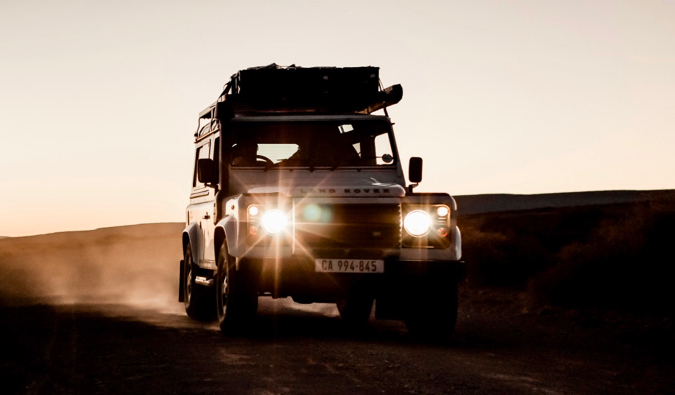
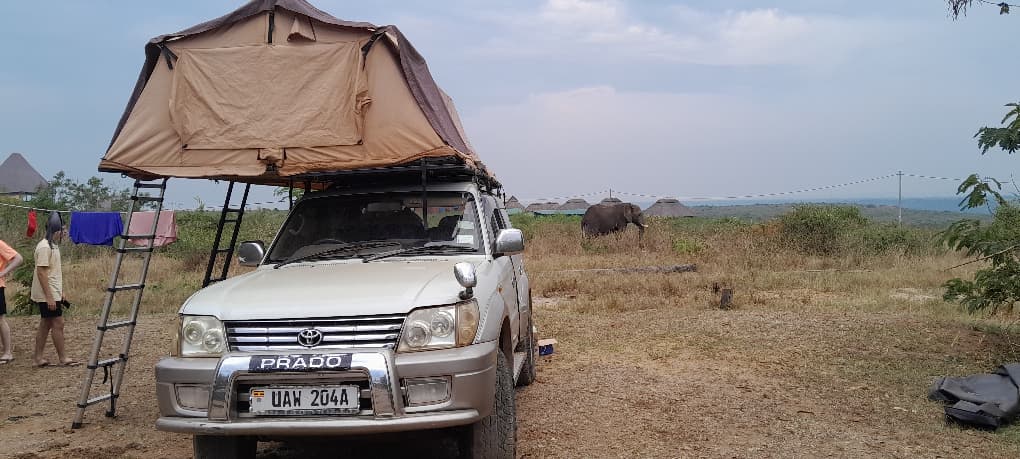
A rooftop tent safari car is exactly what it sounds like: a rugged 4×4 vehicle fitted with a foldable tent mounted securely on its roof rack. The setup allows travellers to drive during the day and sleep safely above ground at night, parked at designated campsites within or near Uganda’s national parks and conservation areas.
The concept originated in Southern Africa — Namibia and Botswana in particular — where vast distances and limited fixed accommodation made mobile camping almost essential. In East Africa, and Uganda specifically, the model has expanded rapidly over the past decade as road infrastructure has improved and campsite networks have grown. Today, rooftop tent travel in Uganda is no longer exclusively for seasoned overlanders. It is accessible, affordable, and deeply rewarding for first-timers and experienced safari-goers alike.
The elevated sleeping position is not merely a novelty. It offers a genuine practical advantage in the bush: you are off the ground, away from insects, surface water, and the occasional curious animal that wanders through a campsite at night.
The Vehicle: Why a 4×4 Is Non-Negotiable
Uganda’s roads are diverse in the extreme. The Kampala–Mbarara highway is smooth and fast; the track descending into Bwindi Impenetrable Forest is steep, narrow, and deeply rutted after rain. The plains of Queen Elizabeth National Park require high ground clearance; the remote routes into Kidepo Valley in the far north demand low-range gearing and serious off-road capability.
For a rooftop tent safari, the Toyota Land Cruiser is the undisputed vehicle of choice. It is the reliable workhorse of African overlanding — dependable, powerful, and supported by a parts network across the country. The most popular configurations for rooftop tent hire include the Land Cruiser GX and Land Cruiser LX, both of which can carry one or two rooftop tents comfortably and come with enough load capacity for full camping gear. The Land Cruiser Prado TX/TZ is the most popular choice for couples or small groups seeking a balance of comfort and capability, available with a single rooftop tent from approximately $85 per day. The larger Land Cruiser V8 and GX models, suited to families or groups of four, accommodate double rooftop tents from around $110 per day.
A Toyota RAV4 is available as the most budget-friendly option, starting from around $50 per day, and handles lighter off-road conditions well during the dry season. For groups of five or more, Safari Vans with pop-up roofs are a practical alternative for game drives, though most travellers in this category opt for a combination of van travel and tented lodge accommodation rather than pure rooftop camping.
What Comes in a Fully Equipped Safari Car?
This is where the real value of a proper rooftop tent package becomes clear. A well-equipped rental from a reputable Ugandan operator is not simply a car with a tent bolted to the roof. It is a mobile base camp. Turnkey packages typically starting around $85 to $150 per day include the vehicle, tent, and a full camping kit.
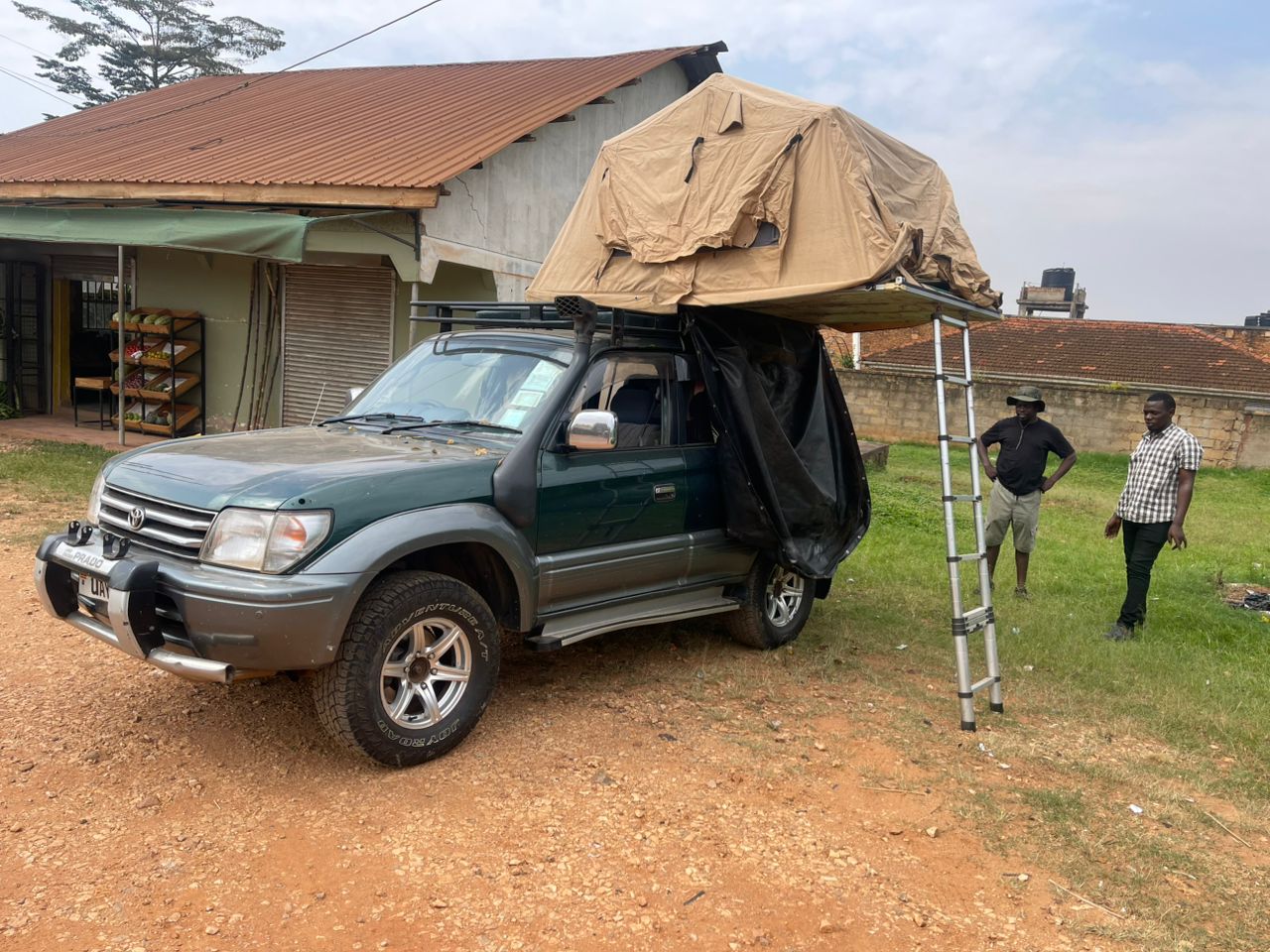
The Tent Itself A standard single rooftop tent sleeps two people on a built-in flat board with a comfortable mattress. Quality tents include mesh windows with blackout panels for ventilation and privacy, a ladder for access, and a weatherproof outer shell. Setup typically takes under five minutes. A double rooftop tent configuration (two tents on one vehicle) accommodates four people — ideal for friends or families travelling together.
Camping Gear Included Reputable operators include a comprehensive camping kit alongside the vehicle and tent. This typically covers folding camping chairs and a table, a cooking gas stove and gas canister, pots, pans, and basic kitchen utensils, plates, cups, and cutlery, a portable cooler box or electric fridge (running off the vehicle’s second battery), a water container, and a basic toolkit for roadside issues. Some operators also supply a washing basin and an outdoor shower bag — a simple but welcome addition after a long day on dusty safari tracks.
Vehicle Equipment Beyond the camping gear, every safari-specification vehicle should come with at least one spare tyre (two is strongly recommended for remote routes), a hydraulic jack and wheel brace, a tow rope, GPS unit or holder for your phone, comprehensive insurance, unlimited mileage, and 24-hour roadside assistance. Always confirm all of these are included before signing the rental agreement.
What It Costs — and Why It Saves You Money
The economics of rooftop tent safari travel are one of its most compelling arguments. A couple renting a Land Cruiser Prado with full camping gear for $85 to $100 per day is simultaneously solving their transport and accommodation in a single daily rate. Compare this to the alternative: a self-drive vehicle at $60 to $80 per day plus a mid-range safari lodge at $80 to $200 per person per night, and the savings become very significant — particularly over a ten-to-fourteen day safari circuit.
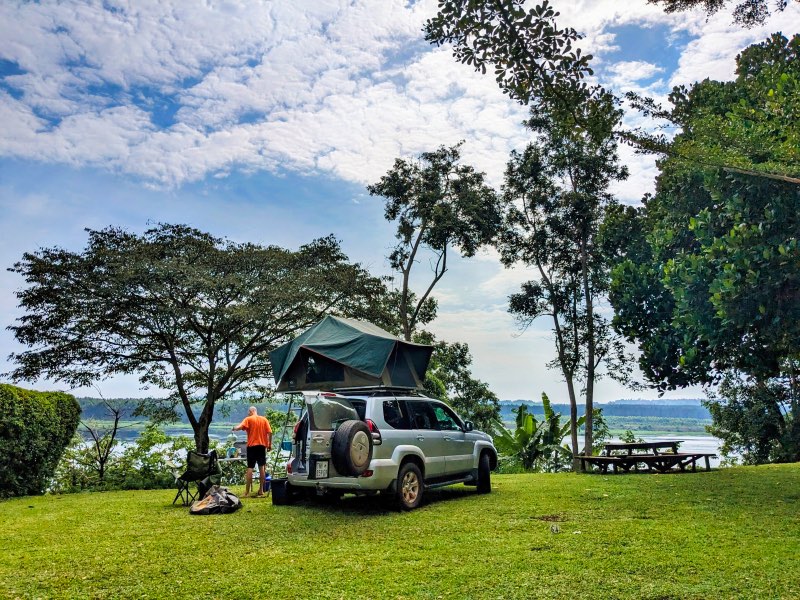
Campsite fees at Uganda’s national parks are modest, typically ranging from $10 to $30 per person per night, and many are located inside the parks themselves — meaning you are already positioned for early morning game drives without a long commute from a distant lodge. The ability to enter parks at dawn and linger until dusk without worrying about being back at a lodge for dinner is, for many travellers, the defining advantage of rooftop tent travel.
Fuel is the main additional cost. A Land Cruiser Prado consumes more on rough terrain than on tarmac, and fuel in Uganda costs approximately $1.40 to $1.60 per litre as of 2026. Budget roughly $20 to $35 in fuel per day depending on your daily driving distance and route conditions.
Where to Go: Uganda’s Best Routes for Rooftop Tent Travel
A classic ten-to-fourteen day Uganda camping circuit offers extraordinary variety. Starting from Entebbe or Kampala, a well-planned route typically heads north to Murchison Falls National Park — home to the Nile, massive hippo pods, large elephant herds, and the world’s most powerful waterfall. From there, experienced overlanders push further north to Kidepo Valley National Park, one of Africa’s most remote and rewarding wilderness areas, before heading south through Kibale National Park (chimpanzee tracking country) and Queen Elizabeth National Park (famous for tree-climbing lions and the Kazinga Channel), ending with a gorilla trek in Bwindi Impenetrable Forest.
Cross-border extensions into Rwanda are possible with the right documentation arranged through your rental operator, making a Uganda-Rwanda circuit — Bwindi gorillas on the Ugandan side, Volcanoes National Park gorillas on the Rwandan side — one of the ultimate East African rooftop tent itineraries.
Tips Before You Go
A few practical points are worth emphasising for first-time rooftop tent travellers in Uganda. Advance campsite reservations are required in most national parks — spontaneous arrival without a booking is not guaranteed. Book campsites through the Uganda Wildlife Authority or your rental operator at the same time you confirm the vehicle. Download offline maps before leaving Kampala, as mobile data disappears in remote areas. Always carry more water than you think you need. Avoid driving after dark outside major towns. And tuck your trousers into your socks at campsites in Bwindi — safari ants are harmless but have a memorable bite.
Most importantly, choose your rental operator carefully. Confirm that the vehicle is recently serviced, that insurance covers off-road damage, and that 24-hour breakdown support is genuinely available in remote areas. In the places a rooftop tent safari takes you, the quality of your vehicle and the reliability of your operator are not minor details. They are the difference between an adventure and a misadventure.
The Verdict
A fully equipped rooftop tent safari car is not just a practical transport solution — it is a fundamentally different way of experiencing Uganda. It trades the predictability of lodge travel for the freedom of the open road, and the comfort of a fixed bed for the incomparable reward of sleeping under the African sky. For travellers willing to embrace that trade, Uganda has never been more accessible, more affordable, or more extraordinary.
The vehicle is ready. The tent is packed. The only question is where you want to wake up tomorrow.