Uganda Tourist Guide 2026: Parks, Permits & Travel Costs
Uganda has earned its nickname, “the Pearl of Africa,” honestly. Few countries let you track mountain gorillas through misty rainforest, watch tree-climbing lions doze over a savannah, raft the source of the Nile, and cruise a hippo-filled channel — all in the space of a single trip, without days lost to long transfers between destinations. If you’re planning a 2026 trip to Uganda, this guide walks through everything that actually matters: how to get in, which parks to prioritize, what it will cost, when to go, and how to move around once you’re there.
Why Uganda Belongs on Your Safari List
Uganda sits on the equator in the heart of East Africa, and its size works in your favor. Compared to Tanzania or Kenya, distances between major attractions are short enough that a two-week itinerary can realistically combine gorilla trekking, chimpanzee tracking, a Big Five safari, white-water rafting, and a Nile boat cruise — without the marathon drive days common elsewhere on the continent.
The headline draw is mountain gorillas. Along with Rwanda and the Democratic Republic of Congo, Uganda is one of only three countries on Earth where you can see them in the wild, and it’s the only place where gorilla trekking and chimpanzee tracking are realistically combinable on one trip. Add in more primate species than almost any other African country, over 1,000 recorded bird species, and the literal source of the Nile at Jinja, and it’s easy to see why Uganda keeps climbing “next big safari destination” lists.
Getting There and Getting Around
Most visitors fly into Entebbe International Airport (EBB), about 40 km south of Kampala on the shores of Lake Victoria. It’s well connected with direct and one-stop flights from Amsterdam, London, Dubai, Doha, Nairobi, Addis Ababa, and Istanbul via carriers like Uganda Airlines, Emirates, Qatar Airways, KLM, and Ethiopian Airlines.

A popular alternative route, especially for travelers heading straight to Bwindi Impenetrable National Park, is flying into Kigali, Rwanda, and driving 4–5 hours across the border into southwestern Uganda.
Once you’re on the ground, how you get around matters more than most first-time visitors expect:
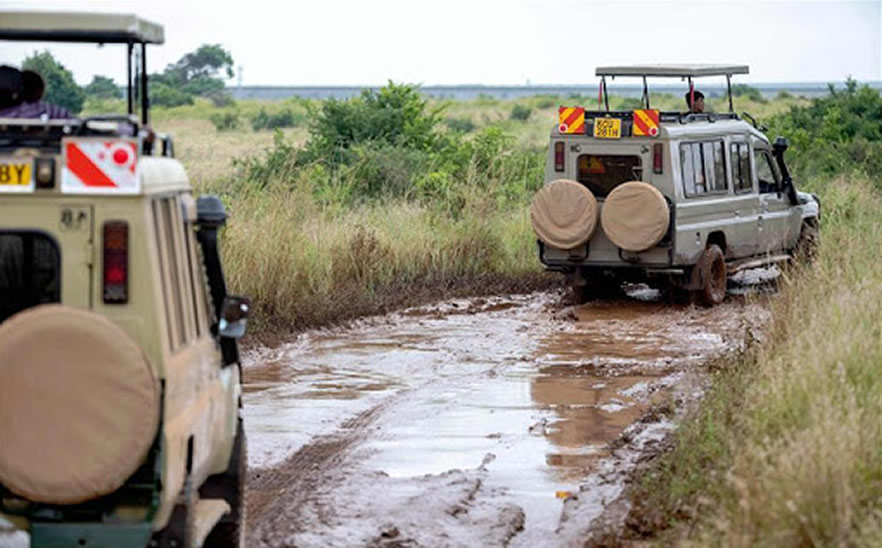
- Private safari vehicle with a driver-guide is the standard and most recommended way to see the parks — usually a 4×4 with a pop-up roof for game viewing.
- Domestic charter flights connect Entebbe to remote parks like Bwindi, Kidepo Valley, and Murchison Falls, saving hours of driving if your schedule is tight.
- Self-drive rentals work well around Kampala and Entebbe, though most visitors opt for a guide-driver given rougher rural roads further out.
- Public buses and boda-bodas exist but aren’t recommended for most tourists on longer routes, due to comfort and safety concerns.
Best Time to Visit Uganda in 2026
Uganda is a year-round destination, but timing shifts both trekking conditions and your budget:
- Dry seasons (peak travel): December–February and June–September. Trails are firmer and wildlife viewing is at its easiest — these are the busiest months for gorilla trekking.
- Green season (better value): March–May and October–November bring more rain and fewer crowds, along with lusher scenery. Notably, gorilla trekking permits are discounted during April, May, and November.
- Best for birding: November–April, when migratory species join Uganda’s resident bird population.
- Chimp tracking: Good year-round, though dry months make forest trails more comfortable.
If flexibility is on your side, the discounted permit months are worth serious consideration — you get a quieter park experience and a meaningfully lower price tag on the trip’s biggest expense.
The Parks You Shouldn’t Skip

- Bwindi Impenetrable National Park — Home to roughly half the world’s remaining mountain gorillas, spread across four trekking sectors (Buhoma, Ruhija, Rushaga, Nkuringo).
- Queen Elizabeth National Park — Uganda’s most bio-diverse park, known for tree-climbing lions in Ishasha and boat cruises on the Kazinga Channel.
- Murchison Falls National Park — Uganda’s largest park, where the Nile forces itself through a narrow gorge, paired with classic savannah game drives.
- Kibale Forest National Park — Widely considered the best chimpanzee tracking destination in Africa.
- Kidepo Valley National Park — A remote, dramatic park in the northeast, often ranked among Africa’s most beautiful and least crowded.
- Jinja and the Source of the Nile — Uganda’s adventure hub, with white-water rafting, kayaking, and bungee jumping.
- Lake Bunyonyi and the Rwenzori Mountains — For unwinding after trekking or, for the more ambitious, tackling the snow-capped “Mountains of the Moon.”
What a Uganda Trip Actually Costs
Budget planning for Uganda comes down to one big-ticket item and everything else:

- Gorilla trekking permit: $800 per person in high season, dropping to $600 during the April, May, and November low-season discount. Foreign residents pay $700; East African citizens pay a locally denominated rate.
- Chimpanzee permits: Considerably cheaper, typically around $200 in Kibale.
- Visa: A single-entry e-Visa runs about $50; the East Africa Tourist Visa, covering Uganda, Kenya, and Rwanda, costs $100 and is worth it if you’re combining countries.
- Mid-range safari package: Roughly $2,500–$4,500 per person for a 4–6 day trip from Entebbe, covering accommodation, transport, and guiding.
- Daily budget: Backpackers can manage on $40–70/day outside of permit costs; mid-range travelers should plan for $150–300/day.
Sample Itineraries
- 3 days — Gorilla Trekking Express: Entebbe → Bwindi → trek → return. Ideal if gorillas are the priority and time is short.
- 7 days — Classic Uganda Safari: Kibale (chimps) → Queen Elizabeth (game drives, boat cruise) → Bwindi (gorillas).
- 10–12 days — Uganda in Depth: Adds Murchison Falls and Lake Bunyonyi to the classic route for a fuller circuit.
- 14+ days — Uganda and Rwanda Combined: Extends into Kigali, Volcanoes National Park, and Lake Kivu using the East Africa Tourist Visa.
A Few Practical Essentials
A yellow fever vaccination certificate is mandatory for entry, and malaria precautions are strongly recommended throughout the country. Uganda is generally considered safe for tourists on established routes, though standard precautions apply, as anywhere. Electricity runs on 240V with UK-style plugs, and local SIM cards from MIN or Airtime are cheap and easy to pick up on arrival.
Planning the Details
Because Uganda’s parks are spread out and gorilla permits sell fast in peak months, the trips that go smoothly are the ones planned a few months ahead — permits booked early, lodges near your trekking sector confirmed, and transport arranged before you land.
For a full breakdown of parks, permit pricing, visa requirements, and season-by-season planning advice, the Uganda tourist guide is a solid starting point — it’s built specifically to help travelers put together a well-paced, realistic Uganda itinerary, whether you’re going self-drive or with a chauffeur-guide.
Whichever route you take, Uganda rewards travelers who give it enough time. The gorillas, the chimps, and the Nile are worth building a trip around rather than rushing through.
To book a Uganda tour online today- simply contact us now by sending an email to [email protected] or call us on +256-700135510.